


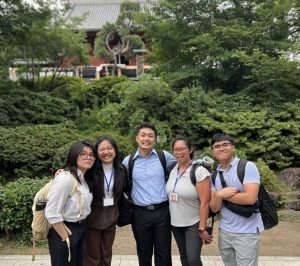
One of the most memorable moments of the trip didn’t happen in a classroom, but over dinner with our mentors. Nearly 40 floors above the city, the Tokyo skyline competed for attention with trays of sushi and perfectly grilled meats. I felt completely out of place—yet, at the same time, like I was living the life of a CEO. Sitting across from healthcare leaders made the challenges of medicine feel real and immediate.
Meeting Dr. Arthur Gianelli, CEO of One Brooklyn Health, stood out in particular. Hearing him speak candidly about insurance claims, hospital sustainability, and systemic barriers felt eerily familiar to what I’ve witnessed while volunteering in the Emergency Department. It was reassuring to realize that the frustrations I’ve seen at the bedside are the same ones healthcare leaders are actively working to solve.
Those conversations pushed me to think beyond patient care alone. I learned that Japan’s ability to provide comprehensive care for patients with chronic disease often comes at a financial loss, which forced me to reconsider what “value” truly means in healthcare. Rather than discouraging me, this insight sparked a deeper curiosity about healthcare administration and policy. By the end of the trip, I found myself seriously considering pursuing an MD/MBA, driven by a desire to better understand hospital systems and advocate for patients within structures that do not always make that easy.
Academically, the trip brought everything I’ve learned into sharper focus. Lectures on global health expenditures, insurance systems, and cost containment became tangible when paired with hospital visits and discussions on value-based payment models in Japan. Our visit to the University of Tokyo was especially impactful, illustrating how national policy decisions shape
daily hospital operations. I will also never forget walking into a room full of seniors at Koyama Memorial Hospital, where cutting-edge imaging technology existed alongside deep respect for tradition—including participating in a blessing ceremony at Kashima Shrine rooted in Shinto, Japan’s oldest religion.
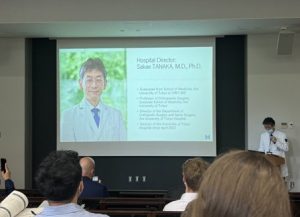
Comparing Japan’s healthcare system to that of the United States further sharpened my perspective. Many patients in Japan begin their care at local clinics rather than emergency departments, which helps explain the calm, almost surreal atmosphere we encountered in some hospitals. That efficiency, however, comes with tradeoffs. Workforce shortages and Japan’s aging population mean that some regional hospitals do not offer pediatric services at all. It was a powerful reminder that healthcare systems evolve in response to the populations they serve. At the conclusion of the program, my team and I shared our insights during a virtual symposium, where Kaiser employees had the opportunity to hear what we learned about global health systems.
Outside of hospital visits and lectures, Japan offered moments that grounded the entire experience. Mornings at the Hanzomon Hotel, first encounters with natto and omurice, wandering through incense-filled temples, and late nights exploring Shibuya with my roommate all became part of the learning. Karaoke sessions that stretched past midnight and one final Don Quijote run before departure felt like our way of savoring every last moment of the trip. 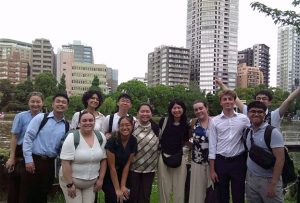
Even after returning home, the impact of the experience continues. Through COPE Health Solutions, I was offered the opportunity to shadow vascular surgeon Dr. Sammy Eghbalieh and remain connected with mentors and program coordinators who continue to support my growth. This experience gave me the confidence to discuss healthcare systems beyond the clinical perspective, expanding how I think about global health and strengthening my commitment to pursuing value-based care that prioritizes patients over paperwork.
The COPE Health Solutions Japan program fundamentally reshaped how I view holistic healthcare systems and value-based care. Experiencing international models firsthand and learning directly from healthcare leaders provided meaningful insight into health policy, insurance structures, and patient outcomes in an engaging and culturally immersive way. This experience deepened my interest in global health, connected me with friends and mentors I continue to learn from, and continues to shape how I approach advocating for sustainable, patient-centered care.
Reilly Chow
International Health Scholar Intensive Alum, Tokyo, Japan – June ’25
Assistant Director of Projects | Health Scholar Leader @ Kaiser Permanente Irvine
Health Scholar, Kaiser Permanente Irvine
Learn more about COPE Health Solutions’ International Health Scholar Intensives here.